
US Secretary of State Marco Rubio’s visit to Armenia, the intensifying political contacts between Washington and Yerevan, correspondence with Donald Trump, the European Union’s growing support for Armenia and the West’s efforts to present Yerevan as a new regional partner are being viewed as the beginning of a new geopolitical phase in the South Caucasus. However, it would be wrong to look at this process solely through the prism of diplomatic relations. A deeper examination of the developments reveals that Armenia is once again repeating the tradition of political betrayal it has demonstrated throughout history.
Associate Professor at the Academy of Public Administration under the President of Azerbaijan and Chairman of the Baku Politologists Club, Zaur Mammadov, told APA that developments taking place in Armenia no longer come as a surprise to Azerbaijani society.

“For us, Azerbaijanis, what is happening in Armenia today is not strange. Azerbaijanis have always been a people who extended a helping hand to their neighbors and lived peacefully with them. However, in return, we have faced great suffering caused precisely by Armenians. Armenians who once lived in Azerbaijani homes, alongside Azerbaijanis and worked in their courtyards, later united, found patrons for themselves in various countries around the world, and, with the support of those patrons, committed massacres against Azerbaijanis in the South Caucasus, carried out genocides, and did everything possible against the Azerbaijani state,” he said.
The political analyst emphasized that Armenia’s expansionist policy has, for years, become a serious source of threat for the region.
“As a result, one day they not only made territorial claims to Karabakh, Yerevan, Nakhchivan and Zangezur, but before the 44-day war they even declared that they would reach Baku. Yes, these are the same Armenians who have territorial claims not only against Azerbaijan, but also against Georgia and even Russia’s southwestern regions.”
Armenia’s historical dependence on patrons

Historically, Armenia has existed under the patronage of great powers and has survived thanks to the support of various geopolitical centers. At different periods, Tsarist Russia, the Soviet Union, and later modern Russia acted as the main guarantor of Armenia’s security, economy, and even statehood. Russia’s role in shaping Armenia’s current borders, building its economic system, ensuring its energy security, and maintaining its military capabilities is undeniable.
For this reason, Armenia’s rapid turn toward the West and its attempts to distance itself from Russia are viewed by Moscow not merely as a political problem, but also as a strategic betrayal. Armenia existed under Russia’s security umbrella for many years, yet after benefiting from those guarantees, it is now trying to move into a different geopolitical camp.
Zaur Mammadov noted that Armenia’s behavior toward Russia is not a new phenomenon and has historical roots.
“If someone in Russia today is surprised or concerned by Armenia’s orientation toward the West, they should not be. Armenia’s betrayal of Russia is not happening for the first time. Beginning from the late 19th and early 20th centuries, Armenian circles participated in terrorist acts against the Russian emperor, formed underground networks against the Russian state, and cooperated with their Western patrons to weaken Russia.”
The geopolitical message behind Rubio’s visit
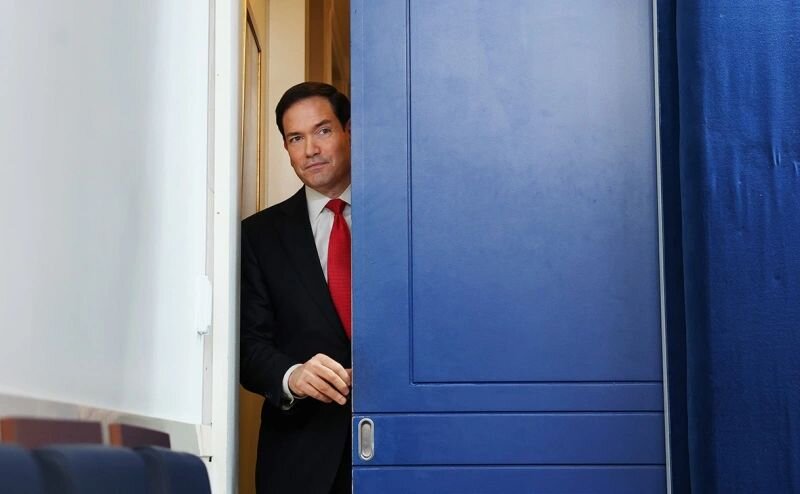
Rubio’s visit to Armenia is particularly significant in this context. The United States is openly trying to pull Armenia out of Russia’s sphere of influence. Washington understands that Armenia is the most convenient platform for changing the geopolitical balance in the South Caucasus. Armenia, in turn, is trying to use these interests to obtain political, financial, and security guarantees from the West.
The role of the European Union in this process is also noteworthy. In recent years, Brussels has allocated major financial packages to Armenia, sent monitoring missions, and increased its political support. Although Europe attempts to present Armenia as a “democratic partner,” in reality, these steps are part of a broader strategy aimed at weakening Russia’s influence in the region.
According to the political analyst, the accusations voiced in Russia today are rooted in much deeper processes.
“If people like Solovyov on Russian television accuse Nikol Pashinyan today, they should look at the issue more broadly. This process did not begin with Pashinyan. There were examples of betrayal against Russia in the 19th century, in the 20th century, and during the Soviet era as well. Even if we recall the metro bombings, we can see this. During the rule of Robert Kocharyan and Serzh Sargsyan, an anti-Russian environment was formed and expanded in Armenia. Despite Kocharyan’s current statements, the foundation of the anti-Russian front in Armenia was laid precisely during the rule of Kocharyan and Sargsyan.”
The expert believes that Nikol Pashinyan is now continuing that political line in a more open form.
“Nikol Pashinyan is continuing this policy. The formation of non-governmental organizations and media in Armenia along an anti-Russian line also took place under previous governments. Today, the Pashinyan administration openly states that it considers Europe and the United States, especially France, among its main pillars of support.”
Armenia remains dependent on Russia

However, a key question emerges here: after decades of dependence on Russia, can Armenia truly integrate fully into the West?
Armenia’s economic, energy, and security systems remain heavily dependent on Russia. Russia plays a decisive role in Armenia’s energy security. If Gazprom were to stop supplying gas to Armenia or sharply raise prices, the Armenian economy could face a severe crisis. The country’s industrial and коммунal systems remain largely dependent on Russian gas.
In addition, the operation of the Metsamor Nuclear Power Plant continues thanks to Russian technology and technical support. Moscow has the ability to suspend or limit technical services at any time, which could create serious problems for Armenia’s energy system.
Russian companies also hold dominant positions in Armenia’s economy, particularly in the extraction of copper and gold deposits. Moscow could inflict serious damage on Armenia’s economy by restricting or suspending the operations of these companies.
Zaur Mammadov stated that the current state of Armenia’s economy is paradoxical.
“In reality, everyone knows that Armenia’s economy is entirely dependent on Russia. The economic growth Armenia experienced in recent years coincided precisely with the period when sanctions were imposed against Russia. The paradox is that while Armenia remains economically dependent on Russia, at the same time, it is handing over its natural resources to the control of foreign circles, together with US and Western companies. This includes hidden negotiations regarding copper deposits, gold reserves, and other resources.”
Russia’s military and economic leverage

Armenia’s dependence on Russia also continues in military and security matters. Russian border guards stationed along the borders with Iran and Türkiye remain one of the key elements of the regional balance. If Russia were to withdraw these forces, Armenia could face serious security problems regarding the protection of its borders.
At the same time, Russia’s 102nd military base in Gyumri remains an important security factor for Armenia. Moscow could send a direct message to Yerevan by conducting large-scale exercises or increasing military activity at the base.
Moscow also possesses extensive economic leverage. Imposing embargoes on Armenian goods, restricting or suspending remittances sent by Armenians working in Russia, could have a serious impact on Armenia’s economy, which for years has relied heavily on external financial inflows.
The political analyst believes that signals regarding pressure mechanisms against Armenia are already being voiced in Russia.
“Against this backdrop, certain pressure signals toward Armenia are already emerging in Russia. Statements are being made about raising gas prices through Gazprom and suspending the operations of Russian companies active in Armenia, especially those working in the copper and gold sectors.”
Why is Moscow not taking harsher steps?
Despite all this, why is Russia not taking harsher measures? The answer lies in Moscow’s broader strategic calculations regarding the region. Russia understands that severe and sudden measures against Armenia could accelerate Yerevan’s complete shift into the Western orbit. Moscow still wants to see Armenia not as a lost ally, but as a partner that can still be kept under control.
At the same time, Armenia remains a geopolitical platform that Russia does not want to lose completely in the South Caucasus. Moscow clearly understands that weakening its influence over Armenia would lead to a further expansion of US and European influence in the region, which contradicts Russia’s strategic interests.
For this reason, the Kremlin currently prefers a strategy of monitoring and containment rather than harsh sanctions and aggressive pressure. Moscow wants to demonstrate to Yerevan that Armenia still cannot completely break away from Russia and that the political promises offered by the West do not amount to real security guarantees.
According to Zaur Mammadov, more visible changes in Armenia’s foreign policy course will emerge in the near future.
“In any case, the June 7 elections clearly demonstrate the ruling party’s line of moving away from Russia and drawing closer to Europe. We can confidently say that if Nikol Pashinyan remains in power, serious decisions will be made regarding the 102nd Russian military base, Gazprom Armenia, and other political and economic issues.”
Armenia once again pursues geopolitical maneuvering
Rubio’s visit and the growing attention of the West toward Armenia demonstrate that a new geopolitical confrontation is taking shape in the region. Armenia, as throughout history, is once again trying to maneuver between major powers. However, in the long term, this policy could expose Armenia itself to even greater geopolitical risks.
History shows that although Armenia has repeatedly changed patrons throughout different periods, it has ultimately failed to create stability and trust in the region. The current behavior toward Russia appears to be a continuation of that tradition. Armenia is attempting to distance itself from the force that provided it with security and economic support for years, yet at the same time, it cannot completely abandon those foundations.
The political analyst believes that the Pashinyan government has already made its geopolitical choice and that this course will accelerate further in the coming years.
“Pashinyan made his choice long ago. Armenia, like some other CIS countries, will move toward integration with the European Union and distance itself from political and economic organizations within the post Soviet space. This is one of the commitments undertaken by political forces brought to power with Western support, and they are trying to fulfill those commitments.”
Conclusion
In this context, Rubio’s visit to Armenia is not simply a diplomatic event. It can also be viewed as an indicator of Armenia’s next geopolitical shift and continuation of its traditional political line.
Zaur Mammadov stated that the consequences of the developments in the region for Azerbaijan and the South Caucasus as a whole require separate analysis.
“The impact of these developments on Azerbaijan and the South Caucasus overall is a separate topic for discussion. However, one thing is clear: Russia should now better understand Armenia’s true nature and realize that this is not only about Nikol Pashinyan’s government. As throughout history, certain forces that present themselves as close to Russia are still ready to betray Russia as soon as the opportunity arises.”

