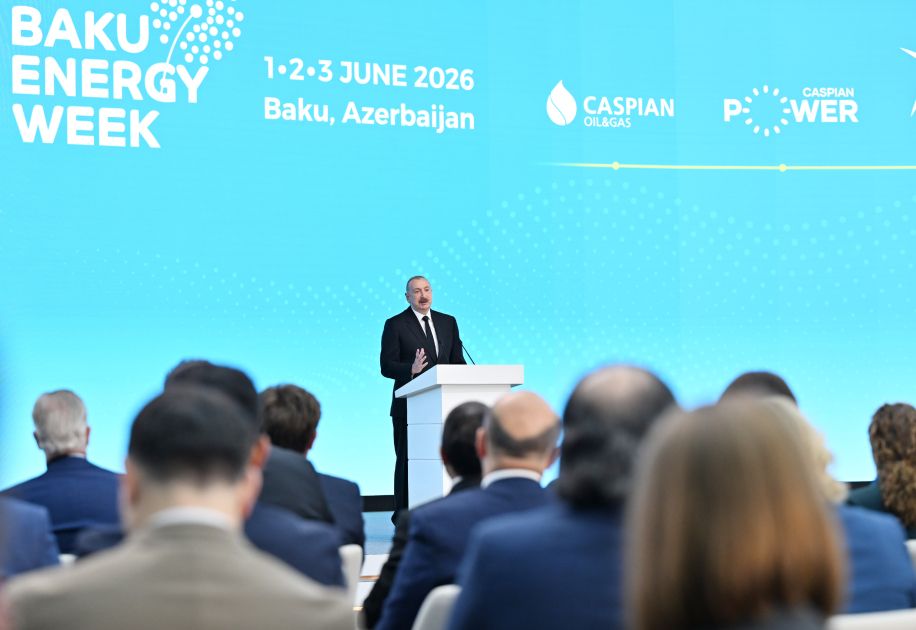
Thirty years ago, Azerbaijan was a country importing electricity and natural gas, with a poverty rate above 50 per cent and nearly a million internally displaced people. This week, it is hosting the 31st Baku Energy Week, one of the calendar's most consequential energy gatherings, with 274 companies from 44 countries, a signed letter from the US president, and a freshly completed $3.27bn acquisition of a major Italian downstream platform. The dichotomy reflects the change that has been taking place not only for the Azerbaijani economy but also for the European energy structure.
This year’s edition, which is taking place at the Baku Expo Center, has grown well beyond its initial purpose of serving as an exposition for Caspian hydrocarbons. It sets out the aspirations of the country under consideration from three different angles: securing additional natural gas supplies for the European Union that continues to be structurally dependent on sources other than Russia; the move towards renewable energy and electricity transfer; and a new stage in down-streaming that involves the participation of state capital from Azerbaijan within Europe.
You may ask, "What has changed this year?" "What is Baku bringing to the table in 2026?"
Key metrics follow as:
- 16 countries are receiving Azerbaijani gas, an increase from 12 countries a year ago.
- 3.72 billion cubic meters (bcm) of Azerbaijani gas were delivered to Europe via the Trans Adriatic Pipeline (TAP) between January and April 2026.
- The target for solar and wind capacity is set at 8 gigawatts (GW) by the end of 2032.
- SOCAR completed the acquisition of Italiana Petroli for $3.27 billion in May 2026.
Gas corridor that Europe now depends on...
It has become a certain trend to use this phrase, as we have been emphasizing over the years that the centrepiece of Azerbaijan's energy story remains the Southern Gas Corridor. 3,500-kilometre integrated pipeline system stretching from the Caspian to southern Italy that has become Europe's most operationally significant non-Russian gas route.
As per the information given by the TAP AG consortium, as many as 3.72 billion cubic meters of Azerbaijan gas had been transported to Europe through the Trans-Adriatic Pipeline within just the first four months of 2026. It is to be noted that today ten EU countries get their gas from Azerbaijan. Yet, capacity limitations represent an ever-growing challenge for the pipeline. As acknowledged by the Azerbaijani government, the Southern Gas Corridor is currently fully loaded. Instead of opting for an EU-wide extension of the gas pipeline project, Azerbaijan chose to establish bilateral deals with European importers. An important agreement was reached last month between German company Uniper and Azerbaijan, which will provide at least 1.5 billion cubic metres of natural gas annually to Germany over the next ten years. Talks are also being held with Balkan countries like Serbia.
The production bump that is imminent is one that would be focused on the extraction of deep gas. This week's conference saw Azerbaijan celebrate the launch of its first non-associated gas production from its Azeri-Chirag-Gunashli field – its large Caspian oil field, which has served as the backbone of the country's upstream sector for nearly three decades. It is estimated that the reserves of non-associated natural gas in this field could be as large as 4 trillion cubic feet in quantity. Alongside developments at the Shah Deniz field, Azerbaijan is set to see a production increase of 8 billion cubic metres per year over the next five years.
It is, however, not in the Caspian that the most significant structural event of the year may have taken place but rather in Italy. In May 2026, SOCAR was able to acquire its interest of 99.82 per cent in Italiana Petroli from API Holding having obtained all relevant approvals for the transaction, including an approval of the European Commission ruling out any potential issues regarding competition. This acquisition, worth around $3.27 billion, will allow SOCAR, the country's state oil company, to obtain two refineries capable of processing a total of approximately 10 million tons annually, as well as a network of 4,500 fuel stations across the country.
This logic is rather simple but very extensive. For years, Azerbaijan has been deriving its value from the beginning of the process, which includes drilling and exporting of raw material, while the refining business was left to Europe. The EU Commission's approval is not only a procedural aspect but also a sign of changing strategy by Azerbaijan in regard to its energy. It is about Azerbaijan shifting from being peripheral to the structure of Europe's energy network to becoming a part of its core. Thus far, TAP has already delivered approximately 47.5 billion cubic metres of gas to Italy, satisfying almost 16 percent of all demand in Italy for the year 2025.
One more thing to add to the Southern Gas Corridor part; the UAE enters into the initiative
Adding further international capital to the network, XRG, the international energy investment arm of ADNOC of the United Arab Emirates, expects the procedures for purchasing a stake in Southern Gas Corridor CJSC from Azerbaijan's Ministry of Economy to be completed in September 2026.
Green ambitions and cable diplomacy
As much as President Ilham Aliyev addressed the reality of the importance of fossil fuels without hesitation, saying, "World cannot live without fossil fuel. We all want to have a better climate to save the planet. We all want to live in a better environment." The pivot to renewables, once dismissed as an idea that was aspirational from a petro-state, is gaining material substance - furthermore, substance per se.
By 2027, Azerbaijan aims to have achieved a 2 gigawatt capacity in solar and wind power generation, while in 2032, this figure will rise to 8 gigawatts. Going even further, Azerbaijan intends to become a transit center for renewable energy sources produced in other regions as well – extending its existing transit policy applied to natural gas for thirty years.
The energy connection of the Black Sea, also known as the Black Sea Energy Cable, which connects Azerbaijan, Georgia, Romania, and Hungary and will be built after the completion of the project’s feasibility studies, would supply renewable energy produced domestically to Europe. There is another energy connection in the works that includes countries like Azerbaijan, Georgia, Türkiye, and Bulgaria; this particular project is in the implementation stage. The Trans-Caspian Green Energy Corridor is a project initiated by a joint venture of Azerbaijan, Kazakhstan, and Uzbekistan, for which the feasibility study is being carried out with the assistance of both the Asian Development Bank and the Asian Infrastructure Investment Bank.
The strategy of promoting renewable energy also helps with the diplomacy of maintaining its expanding oil and gas supplies on the international stage amid climate-related politics in Europe. With the recent conference of COP29, which was held by Baku in 2024, Azerbaijan understands what image calculation means for its diplomacy. The point made by the British Prime Minister Keir Starmer about Azerbaijan having begun exporting energy to Armenia following the previous year’s peace agreement makes it clear that the country's energy deals are part of its overall policy too.
Peace dividend of the region - Zangezur
With the signing of the peace accord between Armenia and Azerbaijan in August 2026, held at the White House, there has been the introduction of a geopolitically oriented element to discussions regarding energy issues. The Zangezur Corridor [a.k.a. Trump Route for International Peace and Prosperity (TRIPP)], provided for in the accord, would serve as an additional branch of the East-West transport network connecting Central Asia and the Caspian to European markets. For Azerbaijan, it represents another logistics node in an increasingly dense web of infrastructure that makes it indispensable to regional connectivity.
The energy supplies to Armenia mentioned by Starmer in his letter merit special attention, since they are a first tangible outcome of the peace process and a sign that Azerbaijan is ready to utilize energy supplies not to exert pressure but to ensure normalization of relations. This is a stark difference from the way Moscow uses its leverage in its own backyard.
With less than a week to go before the elections in Armenia, there is a sense of hope for peace and connectivity in the region. However, with the Kremlin increasing its pressure on Yerevan, attention is firmly on the upcoming elections. For the sake of peace, a sustainable future, nevertheless, this corridor will open, whatever the outcome is this corridor will be opened.
Bottom line
The rise of Azerbaijan as an energy powerhouse has been underpinned by one enduring truth: geography, when patiently monetized, is the most secure source of power. Landlocked, emerging post-Soviet, and having just experienced a disastrous war in pursuit of independence, Baku could ill-afford to indulge ideological niceties. It opened up its oil wells to foreign investment, laid pipes to the coast, and made itself indispensable enough to all sides that it could not be ignored. The Southern Gas Corridor was the first expression of it; the Black Sea cable, the Trans-Caspian green corridor and the Italiana Petroli network are its logical extensions. Each new piece of infrastructure adds another layer of interdependence between Azerbaijan and the countries it supplies, making the relationship progressively harder to unwind.
The risks are always there, indeed. But needless to say, right now it may not be the time to think intensively regarding the issues. Europe needs Azerbaijani gas much more urgently than Azerbaijan needs Europe’s support for any particular market. The risk involved in this downstream move by SOCAR will undoubtedly be noticeable, but the benefits for Baku’s involvement in Europe’s energy market, both politically and economically, are clear. Likewise, while the move towards renewable energy generation may currently be relatively small, it guarantees Azerbaijan will always have a voice, come what may in terms of decarbonisation efforts. For a small, almost landlocked country with no ocean access, that is a remarkable position to have engineered. Whether it constitutes lasting strategic depth or an elaborate hedge against an uncertain future depends, ultimately, on whether the next thirty years resemble the last.

