The President’s regular interviews with local media have already become an integral part of state governance. In these interviews, the country’s domestic stability, its position in regional processes, the security environment, the course of economic development, and the priorities of social policy are clearly explained. One of the most important aspects is that the President does not speak only about the outcomes of decisions, but also explains their political logic and strategic objectives. This gives the public an opportunity to learn about developments directly from the primary source.
These interviews, which have become a tradition, demonstrate that state policy is based not on day-to-day situational reactions, but on a consistent strategy. The protection of Azerbaijan’s sovereignty, security, and regional influence constitutes the main pillars of this strategy. At the same time, social welfare, economic sustainability, and a pragmatic approach to international processes define the political essence of the state’s course.
A clear view of Azerbaijan’s strategic course

This platform ensures that political processes are conducted not behind the scenes, but within an open framework of discussion. As a result, the President’s interviews have become not only a source of information but also an important indicator for understanding the essence of the political line, clearly revealing the country’s forward-looking vision.
One such interview took place on January 5. During a three-hour interview with local television channels, the President of Azerbaijan answered a wide range of questions, covering issues from domestic affairs to global political and economic developments. The head of state provided detailed commentary on Azerbaijan’s position and priorities against the backdrop of the regional security environment and changes in the system of international relations. At the same time, clear messages were delivered regarding socio-economic development, the dynamics of reforms, and the country’s future strategic course.
Zangezur and Araz routes: Azerbaijan’s new transport geopolitics takes shape
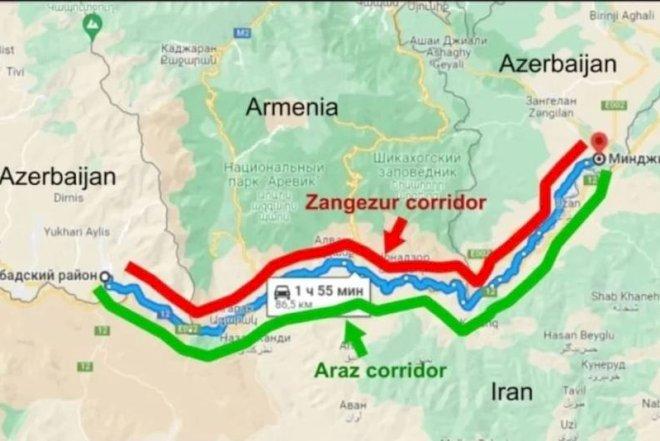
Through his statements on the Zangezur corridor and, in parallel, the Araz route, the President outlined the contours of a new geopolitical phase on Azerbaijan’s transport map. He noted that the Baku–Aghband–Nakhchivan line, new railway connections between Nakhchivan and Türkiye and Iran, as well as a bridge being built over the Araz River, will turn the country into a junction point of the East–West and North–South corridors. This reflects both the integration of Nakhchivan, Karabakh, and East Zangezur into a single economic and spiritual space, and the elevation of Azerbaijan’s transit role to a qualitatively new level.
President Ilham Aliyev noted during the interview that the opening of the Zangezur Corridor has already been approved by the US President: "I am now convinced that the people of Azerbaijan have no doubt that the Zangezur Corridor will be opened. It may have a different name, but that does not change the essence. So all the issues required within the framework of the normalization process with Armenia were resolved the way we wanted. I should also note that, on our initiative, a bridge over the Araz is under construction in the Aghband settlement. So we will actually have two roads from that region to the West and South. One is the Zangezur Corridor through Armenia, and the other is the Araz corridor through Iran. We were the ones who initiated that too. We are building the bridge with our own funds. Currently, to get from the main part of Azerbaijan to Nakhchivan, a long road must be covered from Bilasuvar. It will now be only 45-50 kilometers from the territory of Iran to Nakhchivan. Thus, there will be two connections between the main part of Azerbaijan and Nakhchivan, one through Armenia and one through Iran. We will actually unite Nakhchivan, East Zangezur and Garabagh into one region."
The war has ended; Azerbaijan is living in a reality of peace

In the interview, speaking about Azerbaijan’s peace agenda, President Ilham Aliyev emphasized that with the political conclusion of the conflict with Armenia last year, Azerbaijan has emerged from many years of tension and war and has entered an era of peace:
"It was in 2025 that the Armenia-Azerbaijan war ended from a political point of view, and we have been living in peace for several months now. We are learning what it is like to live in peace since after gaining independence, and even before that, the people and the state of Azerbaijan lived in a state of war. There were different stages of the war. You remember that well. The active stage of the war, the stage of the ceasefire, the Second Karabakh War, the anti-terrorist operation, the period that followed it – all these events ended in August of last year. In other words, Azerbaijan has put a political seal on the brilliant Victory it achieved on the battlefield and, as I mentioned, we did it in the world's number one office. This, of course, will be one of the most memorable events in the history of our independence, perhaps among the first of them. From this point of view, the past year can be regarded as a very successful and historic year for our country, for our people, and I am sure that from now on the people of Azerbaijan will live in peace. Although we have been living in these conditions for only five months, we are already seeing the fruition of this – both on the political and economic planes. There is an upbeat mood in society, there is greater confidence in stability and security. All these factors, of course, have enabled us to successfully move forward and continue to address all the tasks facing the country."
In the modern world, it is not law but real power and mutual alliances that dictate outcomes

On the global stage, the President first explained Azerbaijan’s position against the backdrop of the practical ineffectiveness of international law and the growing prominence of power politics. Recalling United Nations Security Council resolutions remained on paper for 27 years, he described the Second Karabakh War as a just act of self-defense in accordance with Article 51 of the UN Charter, emphasizing that today it is not written law on paper, but real power and pragmatic realities that shape the world:
"There is no such thing as international law in today's world. Everyone should forget about that. There is strength, there is cooperation, there is alliance, there is mutual support. Of course, you must be sure that you are on the right path. No country, no leader should do anything wrong, should not set their sights on the territorial integrity of any country, should not occupy any country. Our greatness and wisdom, as well as our responsibility, are in plain sight. We could have used force in 2020 and in 2023, and in the events that occurred between these years, and given Armenia the response it deserves. Just as our people lived in suffering, just as our territories were devastated, just as war crimes were committed against us, we could have put their cities in the same condition as Aghdam. I can say with full confidence and certainty that no one could have stopped us. We did not do this. Because, first of all, it would have been wrong. Secondly, I was absolutely sure and knew that sooner or later the war, the military conflict must be stopped, and if we did not stop it, it would not stop. The strong side must stop it, and this has already been reported in the media. President Trump's advisor, Mr. Witkoff, said in one of his interviews that President Trump had also asked me at the White House, “Why did you stop? You were the stronger side.” You have probably heard my answer. Therefore, despite this, you must have military power so that no one looks down on you, so that no one harms you. No one should even think of harming you and getting away with that. That is why we are building up our power, including military."
Security cooperation among Turkic states is a strategic necessity

Touching upon Türkiye–Azerbaijan relations, President Ilham Aliyev noted that Azerbaijan cooperates with Türkiye within the framework of formal, including military, alliance relations. Without any intention of creating a military organization, he proposed that Turkic states begin cooperation in this sphere through joint exercises, that relevant messages be conveyed through diplomatic channels, and that all member countries support this initiative.
"We cooperate with Türkiye in the format of an official alliance, including a military alliance and within the framework of military assistance to each other. However, it would be good if Turkic states, which are our family, also began to cooperate in this direction. By proposing this, I am not at all proposing the creation of some military organization. Some have interpreted it that way. No, this is completely unfounded. We are now simply cooperating in the energy sector, in the transport sector, in trade, in investment, and indeed in many areas. Why not cooperate in this area as well? Considering that this is the number one issue for all countries today, my proposal is valid. We are now sending our messages through various diplomatic channels. If there is a general agreement, then we will see these exercises this year. If we see that the exercises were not held, then we should ask the question “Who was not in favor of this?” But I do hope that all member states will support this," the President added.
Cooperation with the United States serves the national interests of both countries

As for Azerbaijani-American relations, President Ilham Aliyev called last year a historic year for Baku-Washington relations: "In the context of US-Azerbaijan relations, 2025 can also be regarded as a historic year. It is no secret that after Azerbaijan gained its independence, the notorious Section 907 hovered over US- Azerbaijan relations like a black cloud. Despite being a newly independent country, Azerbaijan was unable to establish proper relations with America, the number one state in the world. This was the result of the activities of anti-Azerbaijan forces in America, the activities of the Armenian lobby. Azerbaijan repeatedly made such attempts. At certain stages, our relations developed in a positive direction, but the existing restrictions, especially the continuation of the Armenia-Azerbaijan war, did not allow those in power in America to establish comprehensive relations with Azerbaijan. This restriction no longer exists, and, of course, there are two main reasons for that: first, the official end of the Armenia-Azerbaijan war, and second, the fact that President Trump's administration is in power in America. This administration includes members who are very pragmatic and professional, and they know very well what America's national interests are, with the President in charge. Of course, cooperation with a country like Azerbaijan, which has strong potential and influence in the region, is also important for the United States of America. So is it for us. Therefore, from this point of view, last year can also be seen as a turning point. At the White House, President Trump put an end to Section 907 at a ceremony held with my participation there. He removed it. However, Congress has yet to lift it officially. But the step taken by the President, especially in my presence, carries a symbolic meaning, of course."
Decisions on Gaza should be made on a legal and political basis, not emotionally

During the interview, the President of Azerbaijan also addressed the crisis that has emerged in the Middle East, particularly around Gaza. He stated that Baku maintains parallel and reliable partnership relations with both Israel and the Arab-Islamic world, while making it clear that Azerbaijan will not make decisions on military involvement regarding Gaza based on emotions, but strictly within a legal and political framework, taking into account international mandates and real risks. He emphasized that Azerbaijan, as a country that itself suffered from aggression for many years, has no intention of risking the lives and health of Azerbaijanis for the sake of others, and that issues concerning Arab countries should, first and foremost, be resolved by those countries themselves.
"My country has suffered from aggression; it is a country that has endured heavy losses – to a lesser extent in the First Karabakh War, but significantly in the Second Karabakh War. Every Azerbaijani citizen is precious to us. We have no intention of risking the lives and health of Azerbaijanis for the sake of others. When we were in trouble, we were left to our own fate. No one protected us. Furthermore, with all due respect and sympathy for Palestine, Palestine did not particularly protect us either. Yes, there were resolutions from the Organization of Islamic Cooperation (OIC) supported by everyone. We are grateful to all countries for that, just as Azerbaijan has always supported Palestine and the creation of a Palestinian state in the UN, the Non-Aligned Movement, and the OIC. The Palestinian Embassy operates in Azerbaijan, supported in part by Azerbaijani financial assistance. Therefore, I have always maintained that the affairs of Arab countries should be resolved by the Arab countries themselves," the President of Azerbaijan noted.
New fields, new markets – Azerbaijan strategically increases gas exports

During the interview, addressing issues of energy security and the new energy geopolitics, the President noted that Azerbaijan has already become a unique hub supplying natural gas via pipelines to 14 countries, with this number expected to rise to 16 in the near future. He emphasized that thanks to the Southern Gas Corridor, new gas fields, and renewable energy projects, Azerbaijan’s role in Europe’s energy security continues to grow.
Stressing that Azerbaijan has supplied gas to 14 countries so far, 11 of which are on a regular basis, President Ilham Aliyev said that this year, two more European countries will be added to this list: "So in total, it will be 16, and this is the largest number with respect to pipeline gas. No other country in the world supplies pipeline gas to as many countries as Azerbaijan. Our exports last year exceeded 25 billion cubic meters, with potential for growth, and there are two sources of that growth. First, as I already said, renewables. The more renewables we have, the more gas we will save for export. Second, new production from existing or new fields. Among those, we expect new production from the Azeri–Chirag–Gunashli deep gas field. As you know, this field produces a lot of oil, but it also has large gas deposits located at great depth, which is why it is called deep gas. We expect production to start this year. We also expect Shah Deniz to start a new phase in the coming years, which is called Shah Deniz Compression, and this will provide additional gas. Another promising field is Babek, which is very large and holds significant potential, and there are a number of companies interested in investing there. Definitely, the field that can be considered comparable in size to Shah Deniz is Absheron. It is currently producing its first phase, which we buy for local consumption. The second phase of Absheron will give us perhaps three times more gas than it does today, so there will be more for the markets. Our gas is needed in those countries that already receive it and want to increase the volume, as well as in those countries that do not receive it yet."
Azerbaijan as a “regional laboratory” of the energy transition
In addition, the head of state emphasized that wind and solar energy projects implemented with companies such as Masdar, ACWA Power, and bp, as well as planned cable routes along the seabed of the Black Sea and the Caspian Sea, are strengthening Azerbaijan’s position as both a blue and green energy producer and exporter. He noted that the complete rejection of fossil fuels is unrealistic, stressing that the transition to green energy alongside oil and gas must be based on a pragmatic combination. In this context, he presented Azerbaijan as a regional “laboratory” for this energy transition.
"Our wind energy potential alone exceeds 150 gigawatts. There are also, thank God, many sunny days, both in Baku and in all our regions. The wind energy potential of the Caspian Sea isu quite extensive. Therefore, it would be a sin not to use it. When we made these opportunities available to the global energy community, we saw great interest from them. Today, our main investor is Masdar, a company from the United Arab Emirates which built the first solar power plant with a capacity of 230 megawatts. The second plant will be commissioned in the near future. Here, too, the investor is the Saudi Arabian ACWA Power. It is also a 240 megawatt plant. bp has started building a third major plant in the Jabrayil district, also with a capacity of 240 megawatts. This is just the beginning. At the same time, Chinese and Turkish companies are also showing interest. We have also appealed to Azerbaijani companies, and since this is a profitable and a necessary sector for the country, we have also appealed to them. And local companies have already joined the process. At the end of last year, I even laid the foundation stone for two plants in Jabrayil. The map of solar and wind power plants has been approved, both on land and at sea, including on the liberated lands. Currently, our main goal is to expand the capacity to receive this energy. Because according to the existing plans, 6,000 megawatts of solar, wind and hydropower will be included in our system by 2030, and 8,000 megawatts by 2032. In other words, in order to accept and absorb this, we need to strengthen our energy system. This is called the energy grid.

In parallel with this, battery storage systems must also be built. At the initial stage, we appealed to foreign companies to do this work as investors. But we saw that there was no particular interest. That is, we are already installing the first batteries with a capacity of about 250 megawatts, but there will be even more. Because, let me repeat, our short-term plans are to obtain 8 gigawatts of energy," President Ilham Aliyev stated.
All of this shows that the President’s extensive interviews with local media are not merely about making political statements, but about openly presenting the state’s strategic course to the public. The head of state’s position is that Azerbaijan’s future development model should be built on a strong army, a sustainable economy, a balanced foreign policy, and socio-political stability rooted in national values.
This approach is not only an analysis of current realities, but also serves as a roadmap for the long term. The President’s interviews create conditions for the institutionalization of political dialogue, for explaining the essence of decisions, and for more active integration of society into ongoing processes. Ultimately, this format both strengthens the principle of state accountability and serves as an important political platform that reinforces Azerbaijani society’s confidence in the future.

