- Azerbaijan's Dividends in the "Peace Council": In the Spheres of Security, Politics, and Economy
- Azerbaijan is the only country that maintains direct diplomatic dialogue channels with all the key parties to the Middle East settlement. It presents no difficulty for Baku to engage in communication and discuss any issue with Tel Aviv, Tehran, Ankara, and Washington, as well as with the Gulf countries
- A generalization of the experience accumulated on the eve of such significant events as the "Contract of the Century," the implementation of the TANAP-TAP projects, the signing of the "Joint Declaration on the Southern Gas Corridor," the 2013 presidential elections, the Second Karabakh War, local anti-terrorist measures, and COP-29 shows: at this decisive stage of human history, new waves of pressure may begin against our state, which has taken a highly successful political position.
- Since the internal political situation in Azerbaijan is stable, the contours of plans to create levers of external military-political pressure by bringing anti-Azerbaijani groups to power in Armenia are becoming visible.
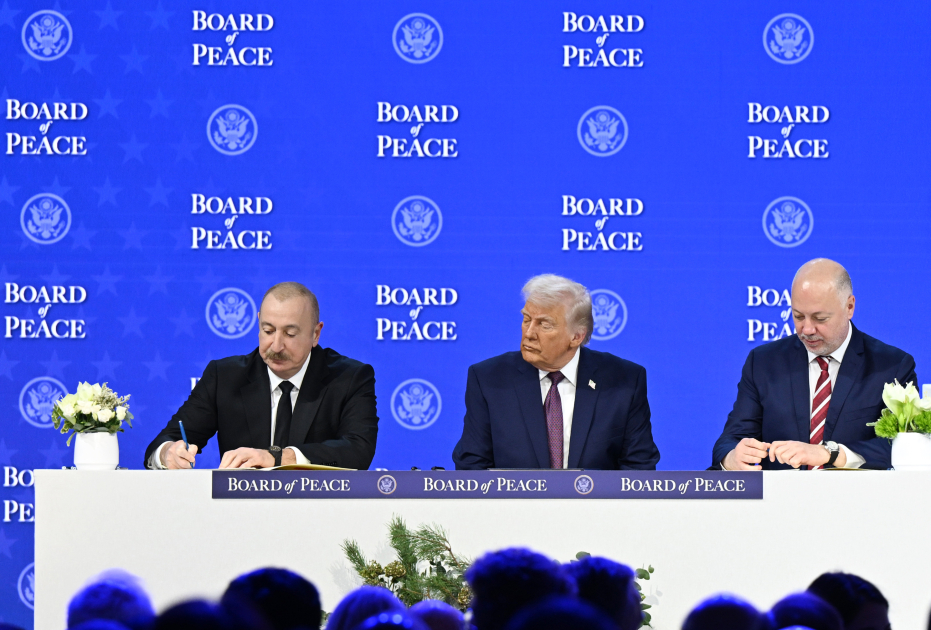
Discussions about the essence of the Peace Council, established on January 22 in Davos, its place and role in international politics, as well as the security mechanisms it creates, compel everyone to reflect.
There are 3 crucial points:
- For the first time in the history of our independence, as well as in the era of our generation, Azerbaijan becomes a founder of such a major international coalition.
- This coalition is being created under the leadership of the USA, and it is extremely important to understand the essence of their plans and forecast their future.
- What can participation in the Peace Council give Azerbaijan?
As we have already noted, since Azerbaijan's participation in an international coalition of such global influence under a regional "umbrella" is happening for the first time, the only way to understand this is through the method of historical analogies and comparisons.
The Peace Council in Historical Context
The historical events taking place today resonate with processes observed at previous stages of similar global transformations. Whatever this Council is called, it is an International Coalition (a political union of two or more states to achieve a common goal – I.M.).
Such coalitions were formed at all historical stages, on the eve of decisive global and even regional confrontations; they were presented as creating a "balance of power," and the negotiating tables they set became places for redrawing the world.
- In the late 18th century, Great Britain, Holland, Spain, Portugal, Prussia, and Austria created a coalition to contain the expansionist policy and revolutionary ideology of France.
- In 1815, the goal of the coalition, named the "Concert of Europe," was the removal from power of Napoleon, who represented a common threat, and the achievement of common interests.
- In 1882, the Triple Alliance was created, and in 1907 — the opposing Entente. The First World War became a settling of scores precisely between these two coalitions.
- On the eve of the Second World War, Germany, Italy, and Japan on one side, and Great Britain, France, China, and later the Soviet Union and the USA on the other, having created alliances, waged a struggle for world domination.
- In 1884–1885, under the leadership of Otto von Bismarck, 14 states, including Germany, England, France, Portugal, Belgium, the USA, and the Ottoman Empire, gathered at the Berlin Conference to discuss the fate of Africa.
At the current stage, undoubtedly, a process of creating coalitions is also underway, essentially different from those that existed in the 19th and early 20th centuries, and the Peace Council is the next stage of this process.
However, unlike the coalitions of the listed periods, the logic of current alliances is different. The current situation resembles the period before World War II — the 1920s–30s, when the League of Nations tried to ensure collective security but ended up inactive due to the lack of enforcement mechanisms for decisions, as well as the times when the US convened the Washington Naval Conference to manage the naval forces of 9 states.
The Peace Council in Today's Global Context: The USA and 6 Regional Coalitions
"The New Atlantic Charter"
In the period from the beginning of the destruction of the old world order to the present day, and more specifically starting from 2021, the USA prefers to create coalitions in 6 different regions corresponding to the realities of each region. At the origins of the process of creating new coalitions stands "The New Atlantic Charter" (June 2021), signed by the USA and Great Britain. Interestingly, this Charter is an update of the document signed by Roosevelt and Churchill in 1941, at the beginning of World War II. The document covers 8 areas of cooperation, including the defense of democracy, reaffirmation of collective security, and the building of a sustainable global trade system.
AUKUS
Following this, on September 15, 2021, the AUKUS coalition was created, the core of which comprises Australia, the UK, and the USA. It was formed by the USA to compete with China in the Far East and the Indo-Pacific basin. Canada, Japan, New Zealand, and South Korea are major regional partners and potential members of AUKUS.
QUAD
Another group uniting the USA, Japan, India, and Australia under the name QUAD plans to move from political statements to active operational joint activity in the Indo-Pacific region in 2025–2026. This group is intensifying rhetoric regarding territorial disputes in the South China Sea. QUAD intends to become a deterrent platform against the spread of China's influence through the concept of a "Free and Open Indo-Pacific."
"The Squad"
The group "The Squad," created by the USA, Japan, and Australia, this time without India but with the participation of the Philippines, was formed to create a balance against China's influence in the South and East China Seas. Unlike QUAD, which covers a wide range of issues, the Squad focuses on security and defense spheres. The possibility of attracting New Zealand and South Korea, as well as India, to the "Squad" is being discussed.
The "Ramstein" Group
In 2022, against the backdrop of the Europe–Russia confrontation surrounding the war in Ukraine, the "Ramstein" group emerged, uniting 57 countries, including NATO and EU members, under US leadership on Eastern European issues.
The US Latin American Coalition
The circle of US partners in their Latin American policy was defined during the operation in Venezuela and in subsequent conditions. They can be divided into 3 groups: those providing direct, including logistical, support for the operation in Venezuela (Britain, Dominican Republic, El Salvador, Trinidad and Tobago), those providing political support to the USA (Argentina, Ecuador, Peru, Guyana, Panama, Paraguay), and opponents of the US operation (Brazil, Mexico, Colombia, Cuba, Russia, China, Iran).
The "Quartet" in North Africa
In January of this year, during negotiations with Egyptian President El-Sisi, the US discussed the creation of "The Quartet," consisting of the USA, Egypt, Saudi Arabia, and the UAE. The goal of this coalition, covering the North African region, is regional stability, peace in Sudan, and issues of disputes with Ethiopia and Sudan regarding the water resources of the Nile River.
The already established Peace Council has formed a coalition of US partners for the Near and Middle East. To forecast the future of this coalition, it would be correct to look at the experience of coalitions formed during periods of historical transformation.
Lessons from the History of Coalitions
For example, the "Concert of Europe" of 1815 became a group of states that redrew Europe after the victory over Napoleon. The Entente shaped the global order after World War I, and the USA, USSR, and Great Britain with other small partners — after World War II. That is, those in the coalition are those who secure a place for themselves among the states that make decisions and are capable of protecting their interests.
The G7 and the NATO coalition used the collapse of the USSR to ensure their global interests. Back then, because we were not in coalitions, we fell into the list of losers, and our lands were occupied. However, at the next stage, two important processes occurred: we became stronger, and the G7 expanded to the G20; the world became multipolar, which expanded the possibilities for international maneuvering for Azerbaijan.
Using the opportunities created by multipolarity and internal strength as effectively as possible, Azerbaijan in 2026 became a founding member of a coalition deciding the fate of the Near and Middle East.
This signifies recognition by the United States of Azerbaijan's regional power, leadership, and influence capabilities on global politics. Now Azerbaijan is a founder of one of the strongest existing coalitions in the world. This is the highest diplomatic, foreign policy, and international status of our country, which has never existed before.
The experience of previous similarly powerful coalitions shows that membership in the Peace Council raises Azerbaijan from the status of an object of discussion at the political table (as was the case in the 1990s) to the status of a discussing participant.
For example, small allies of the coalition victorious in World War I — the Entente — gained the opportunity to expand their territories, achieved reparations, and international recognition. In some cases, they turned into solid nation-states. Romania doubled its territory. Serbia annexed Montenegro, Bosnia and Herzegovina, Croatia, Slovenia, etc. Belgium took possession of some German territories. Greece expanded its territories in eastern and northern directions. Portugal took possession of the port of Kionga. These countries entered the League of Nations as independent states and received compensation from Germany and its allies in various forms.
During World War II, the small allies of the "Big Three":
- Restored their independence.
- All these countries became founders of the UN and received voting rights in world politics. For example, Yugoslavia, having received the Istrian peninsula, an island in the Adriatic, and the port city of Zadar from Italy, became a regional leader. Greece received the Dodecanese islands, including Rhodes, from Italy. Poland annexed vast territories of Germany in the west and north, etc.
These examples, cited from the history of the First and Second World Wars, do not at all mean that Azerbaijan's goal in becoming a founder and member of the Peace Council is expansion at the expense of new territories. The strategy announced by President Ilham Aliyev in an interview with local TV channels — the concept of "Ethical Realpolitik," and the designation of international law and ethical values as fundamental principles of international policy, is the formula for action for the current period.
Azerbaijan's Dividends in the Peace Council: Security, Politics, and Economy
Additional Security Insurance
Azerbaijan's main goal in Peace Council membership is the preservation of the country's security, territorial integrity, sovereignty, and independence against the backdrop of deteriorating global security conditions. This also includes preserving the geopolitical reality formed in the region after the 44-day war and the existing status quo, which affirmed Azerbaijan as the leader of the South Caucasus. The third goal is ensuring the security of the South Caucasus as a whole.
Economic Dividends
Another goal of participating in the Peace Council is ensuring economic profitability and the further development of the Middle Corridor (Orta Dəhliz) along with its security. It is precisely the elevation of the Middle Corridor's development to a new level that can become a very important economic dividend we receive from the Peace Council.
Even plans for Azerbaijan's joint participation with the U.S. in the 'Trump route' could be a subject of discussion. Azerbaijani companies possess such potential and have experience collaborating with U.S. companies.
Participation in the Council provides favorable political conditions for the participation of Azerbaijani companies in the reconstruction of Gaza. Membership transforms Azerbaijan and the South Caucasus into one of the safe regions of the world, which increases the region's investment attractiveness for foreign capital.
Geopolitical Dividends
First of all, Azerbaijan seriously insures itself to preserve independence, territorial integrity, and sovereignty in this complex period. On the other hand, it secures advantageous conditions in the formation of the new world order. Participation in the Peace Council coalition has strengthened Azerbaijan's role as a bridge between Central Asia and Europe.
Both relations with the USA and membership in the Peace Council show that President Ilham Aliyev, proceeding from such important principles of international politics as "correspondence to the balance of power" and "balancing," uses newly forming mechanisms to prevent threats to the region. This is a successful practical application of the principles of flexibility and adaptability of "Realpolitik" in foreign policy.
If we consider that in the Peace Council, which was officially joined by 20 states in Davos, there are 4 members of the Organization of Turkic States (OTS) — Turkey, Azerbaijan, Kazakhstan, and Uzbekistan, as well as our closest allies in the persons of Hungary and Pakistan, we can say that we possess a very serious faction of 6 states. If we add Saudi Arabia, Qatar, the UAE, and Kosovo to this row, which have good relations with Turkey and Azerbaijan, we will see a significant growth in diplomatic potential.
True, decisions in the Peace Council are not made based on consensus, but the experience of how the US respects the interests of Ankara and Baku in matters of Syria (with Turkey) and the Zangezur Corridor (with Azerbaijan), proceeding from D. Trump's compromise principle of "win-win," gives grounds to believe that the White House will come to a common denominator with those who have "real power" in the Peace Council.
Essentially, it is obvious that the Council is a joint coalition created by the USA and the OTS to solve Middle Eastern issues. Azerbaijan and Turkey constitute the forward front of this coalition. Participation in the Peace Council, covering the Near and Middle East, turns the OTS, and especially in the context of Iran, where Azerbaijanis make up a significant part of the population, into the holder of a very weighty say. Thus, at this stage, the importance of Pakistan, which has a very long border with Iran, increases especially alongside Azerbaijan, Turkey, Kazakhstan, and Uzbekistan.
The Peace Council is a convenient platform and a real mechanism for influencing the Iranian issue. Azerbaijan and Turkey, from the platform of the Peace Council, can prevent the adoption of radical measures against Iran, contribute to the security of the Iranian population, and become a leading factor for solving problems through negotiations.
There are all resources for this. Iran's reformist President M. Pezeshkian is also a politician possessing the potential to give impetus to directing processes into a peaceful channel. Azerbaijan, from the point of view of deep historical, national, religious, confessional, and interpersonal ties (presence of kinship bonds) with Iran, stands in the front row among the most significant players.
Azerbaijan is the only country that maintains direct diplomatic dialogue channels with all the key parties to the Middle East settlement. It presents no difficulty for Baku to engage in communication and discuss any issue with Tel Aviv, Tehran, Ankara, and Washington, as well as with the Gulf countries. In the Peace Council, there is virtually no other country capable of combining such political-diplomatic potential with real levers of influence.
Regarding Iran in the Peace Council, the USA and Israel (its accession is expected) represent the most radical positions, while Turkey and Azerbaijan represent conciliatory ones. This position gives Turkey and Azerbaijan effective levers for a peaceful settlement of the situation around Iran, playing the role of a bridge. This gives grounds to say that the prevailing conditions will bring Iran closer to Azerbaijan and Turkey. The only force capable of leading Iran out of the situation is Turkey and Azerbaijan. And founders' status and membership in the Peace Council provides Azerbaijan and Turkey, with the support of the OTS and Pakistan, a very powerful diplomatic field.
Big Goals and Obstacles
These factors, along with creating advantages for Azerbaijan, may also become a reason for increased pressure on our country.
A generalization of the experience accumulated in moments when Azerbaijan was subjected to external and internal political pressure, and the head of state became a target — on the eve of such significant events as the "Contract of the Century," the construction of BTC, discussions and decision-making on TANAP-TAP, the "Joint Declaration on the Southern Gas Corridor" of 2011, the presidential elections of 2013, the "Eurovision" contest, the European Games, the Second Karabakh War, local anti-terrorist measures, and COP-29 — shows that at this decisive stage of human history, new waves of pressure will begin against our state, which has taken a highly successful political position.
However, the resolution of the conflict with Armenia has already removed levers of geopolitical and military pressure on Azerbaijan from the agenda. Also, there are no economic and financial instruments to pressure our country from the outside. Therefore, attempts to worsen internal political conditions and increased pressure, especially on the head of state, may be used to weaken Azerbaijan's positions.
We see some signs of tension in anti-Azerbaijani camps. Even the ultimate goal of processes observed inside Armenia is Azerbaijan. Thus, since the internal political situation in Azerbaijan is stable, the contours of plans to create levers of external military-political pressure by bringing anti-Azerbaijani groups to power in Armenia are becoming visible.
Therefore, our mobilization as a society is a very important, even fateful question. The "ship" is passing through a basin with storms and whirlpools, where there are also dangerous underwater rocks. In such situations, strict safety protocols are applied both for the crew and for the technical condition of the ship.
Ibrahim Mammadov
PhD in History

